
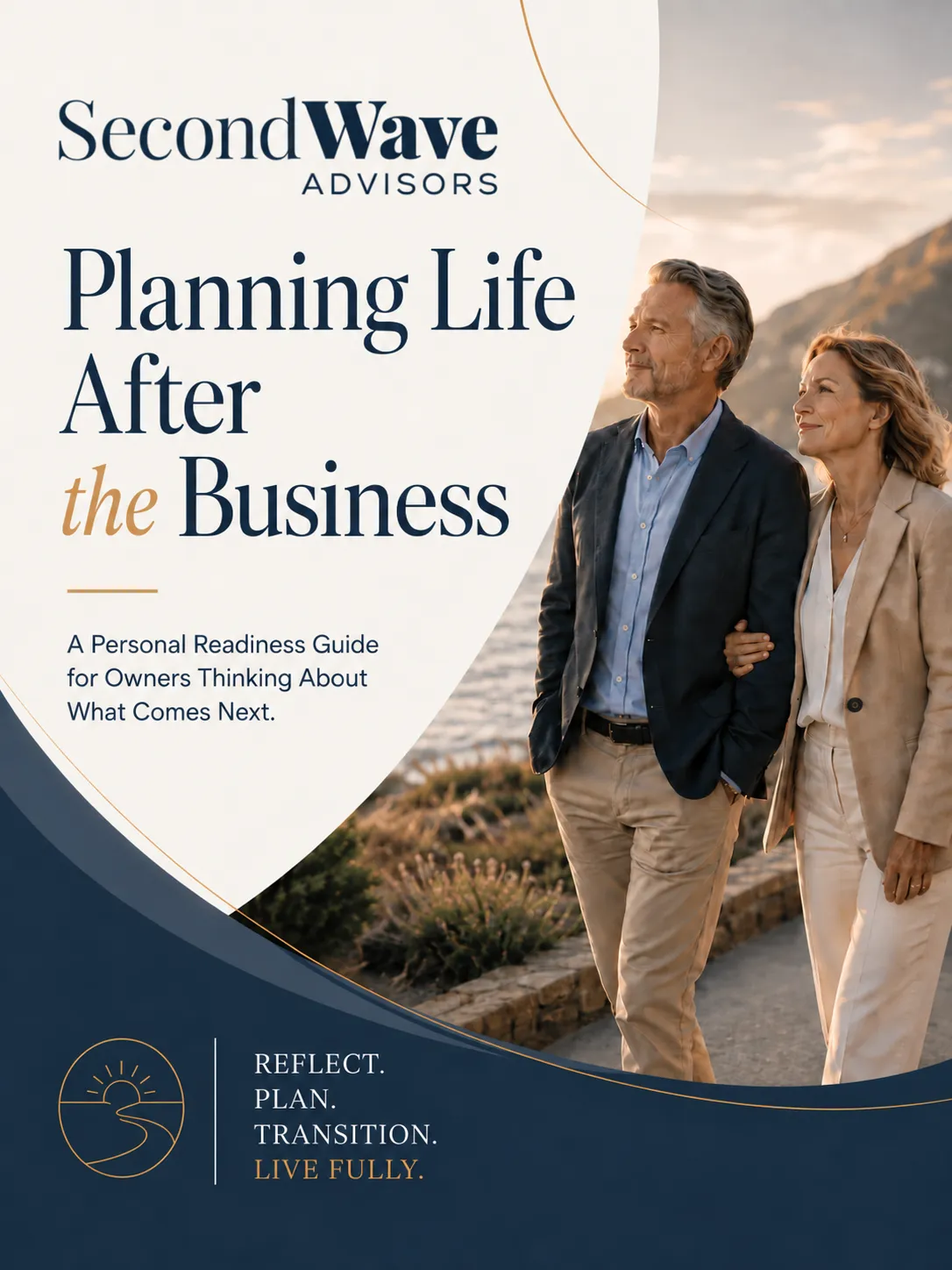
PLANNING LIFE AFTER THE BUSINESS
Begin Envisioning Life After the Business Before a Transition Becomes Immediate
A future business transition can change far more than ownership. It can reshape your daily routine, relationships, sense of purpose, identity, and how you choose to spend your time.
This guide helps you begin thinking about what you may want to move toward before decisions about leaving the business become more immediate.
Free guide. Delivered by email.
The Next Chapter Is Often Less Defined Than the Transition
Knowing How to Leave the Business Is Not the Same as Knowing What Comes Next
For many owners, the business provides more than income. It can shape daily structure, relationships, identity, responsibility, and purpose. Without a clear picture of what comes next, even a well-planned transition can create uncertainty.
1.
Daily Structure May Disappear Quickly
Years of meetings, decisions, responsibilities, and routines can end faster than expected, leaving a very different daily rhythm.
2.
Purpose May Need to Be Rebuilt
The business may have provided challenge, achievement, contribution, relevance, and a strong sense of being needed.
3.
Relationships and Roles May Change
Family, employees, partners, peers, and community relationships may feel different when your role in the business changes.
A More Intentional Way to Look Ahead
Plan Toward Something, Not Only Away from the Business
The goal is not to have every detail of your future figured out. It is to begin considering the roles, relationships, priorities, and possibilities that could make your next chapter meaningful.
No final exit date required
No assumption that you want to retire completely
No requirement to leave business activity behind
Useful whether your next chapter is near, years away, or still undefined
WHAT YOU WILL EXPLORE
Six Areas That Can Help You Imagine Life After the Business
The guide helps you explore practical and personal questions that can influence how you design a meaningful next chapter after the business.
Y
Your Future Week
Imagine how you may want to structure a typical week when the business no longer determines your schedule.
Y
Purpose and Contribution
Consider the work, causes, roles, or activities that may continue to provide meaning, challenge, and contribution.
Y
Relationships and Community
Reflect on family, friendships, professional relationships, mentorship, and community connections you may want to strengthen.
Y
Health, Lifestyle, and Personal Priorities
Explore how health, travel, learning, recreation, personal goals, and family time may fit into your future.
Y
Continued Business Involvement
Consider whether a board, advisory, consulting, investing, mentoring, or ownership role may still be part of your next chapter.
Y
Questions to Begin Addressing Now
Identify assumptions, uncertainties, and conversations that may deserve attention before a transition becomes more immediate.
Why Begin Before a Transition Is Immediate
A Meaningful Next Chapter Usually Takes Time to Develop
Purpose, routine, relationships, and future roles often develop gradually. Beginning the conversation earlier gives you more time to explore possibilities before a transition has already occurred.
Y
More Time to Explore Future Possibilities
Consider different roles, routines, interests, and commitments before relying on them as the foundation of your next chapter.
Y
Greater Clarity About Continued Involvement
Think through whether you want a clean break, gradual transition, advisory role, investment role, or another form of continued involvement.
Y
Better Coordination With Family and Financial Planning
Lifestyle goals and personal priorities can be considered alongside family expectations, liquidity needs, timing, and transition options.
Benefit
Approved Copy
More Time to Test Future Possibilities
You can explore interests, roles, routines, and commitments beforerelying on them as the foundation of your next chapter.
Greater Clarity About Continued Involvement
You can consider whether you want a clean break, a gradual transition,or a defined future role.
Better Coordination with Family and Financial Planning
Lifestyle goals and personal priorities can be considered alongsidefamily expectations, liquidity needs, timing, and transition options.
What are the three step plans
Step 1
Request the Guide
Complete the short form and the download linkwill be sent to your email.
Step 2
Review the Personal Readiness Areas
Use the guide to identify the questions, concerns,priorities, and future possibilities that stand out.
Step 3
Choose an Appropriate Next Step
Continue reflecting independently, complete theExit Readiness Assessment, or discuss theplanning considerations with an advisor.
GET THE FREE GUIDE
Get the Planning Life After the Business Guide
Explore the questions around purpose, identity, relationships, lifestyle, time, and future involvement that may shape your next chapter.
Complete the form and we’ll send the guide directly to your email.
What Happens Next
Step 1
Check Your Email
Your download link will be sent after you submit the form so you can access the guide when it is convenient for you.
Step 2
Review the Guide at Your Own Pace
Use the guide to explore the purpose, identity, lifestyle, relationship, and future-role questions that feel most relevant to you.
Step 3
Consider the Assessment
If you would like a more comprehensive view, complete the Business Owner Exit Readiness Assessment to explore business, financial, and personal readiness.
Step 4
Consider What Deserves More Thought
Use what you learn to identify areas you may want to explore further on your own, with family, or with your advisor.
FAQ Section
Who is this guide for?
This guide is designed for business owners who want to begin thinking about what life may look like after a future transition, even if they are not planning to leave the business in the immediate future.
Do I need to be planning an immediate exit?
No. The guide can be useful whether a transition is approaching, several years away, or still undefined. Earlier reflection gives you more time to explore future possibilities without pressure.
Does the guide assume I want to retire?
No. Life after the business does not necessarily mean retirement. You may want to remain active through consulting, investing, board work, mentoring, philanthropy, another business, or other forms of involvement.
What happens after I submit the form?
After you submit the form, the Planning Life After the Business Guide will be sent to the email address you provide. You may also receive additional educational information related to exit readiness and business transition planning in accordance with your communication preferences and consent.
Is this guide professional or mental health advice?
No. The guide is an educational planning resource intended to help you reflect on personal-readiness considerations. It is not a substitute for financial, legal, tax, medical, mental health, counseling, or other professional advice.
Do I need to know what I want to do next before using the guide?
No. The purpose of the guide is to help you begin exploring possibilities. You do not need to have a future role, lifestyle, schedule, or next chapter already defined.
Start Designing a Next Chapter That Is About More Than Leaving the Business
Request the guide to explore the purpose, structure, relationships, activities, and future roles that may shape life after the business.
This page and the Exit Readiness Discovery Call are provided for general educational and introductory discussion purposes only. The conversation is not a valuation, formal readiness assessment, due-diligence review, or substitute for individualized legal, tax, accounting, investment, financial, transaction, estate-planning, or other professional advice. No outcome is guaranteed.
Contact :
Andrew Williams | Second Wave Advisors 3091 Park West Ct. 888-993-9283 | [email protected] https://secondwaveadvisors.com/
© 2026 Second Wave Advisors. All rights reserved.