
Family Alignment and Business Transition Guide
Bring Greater Clarity to the Family Questions That Can Shape a Future Business Transition
Explore the communication, expectations, ownership, leadership, fairness, successor, and family-role considerations that can influence both the transition itself and the relationships surrounding it.
The goal is not to force agreement. It is to help surface important questions before assumptions become harder to resolve.
Free guide. Delivered by email.
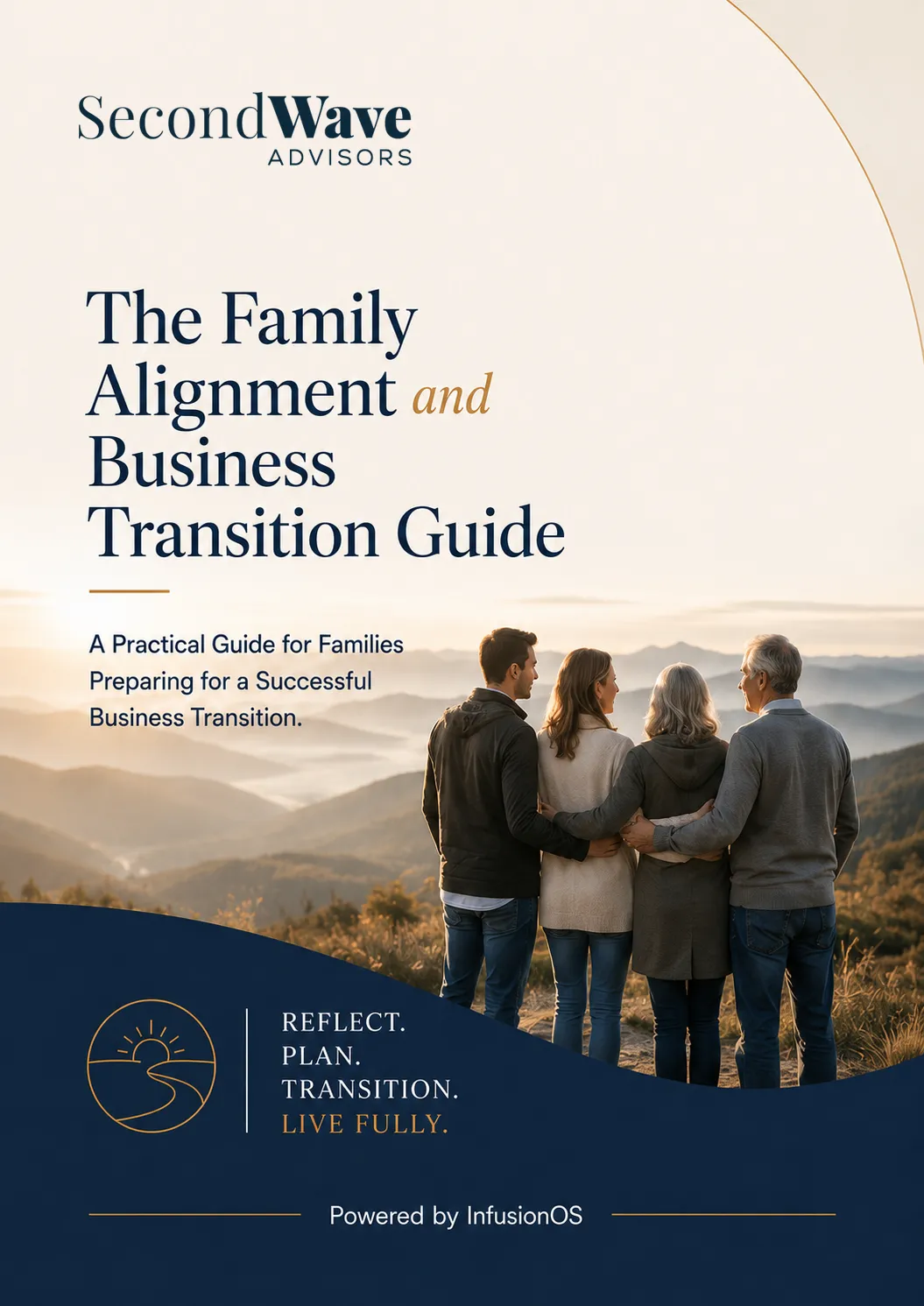
Family Expectations Are Often Assumed Before They Are Discussed
A Future Business Transition Can Affect People in Very Different Ways
Family members, co-owners, potential successors, and key leaders may have very different expectations about ownership, leadership, timing, fairness, and the owner’s future role.

Important Expectations May Remain Unspoken
People may make assumptions about ownership, leadership, inheritance, employment, financial outcomes, or future involvement without ever discussing them directly.

Family and Business Roles Can Become Blurred
Ownership, family relationships, employment, governance, and decision-making can easily overlap in ways that create confusion or tension.

Delayed Conversations Can Increase Pressure
When communication begins only after a triggering event or deadline, there may be less time to understand concerns, clarify expectations, and consider alternatives.
A More Structured Place to Begin
Separate Assumptions from the Questions That Need Thoughtful Discussion
This guide provides a practical framework for considering owner intentions, family expectations, roles, successor interest,fairness, communication, and the people who may be affected by a future transition.
No final transition decision required
No assumption that the business will remain in the family
No requirement that all family members participate
Useful whether a transition is near, years away, or still undefined
INSIDE THE GUIDE
Six Family Alignment Areas Worth Exploring
Use the guide to identify expectations, assumptions, communication needs, and unresolved questions that may affect future decisions.
Owner Intentions
Clarify what you currently want from a future transition, including timing, involvement, ownership, and what you hope comes next.
Family Expectations
Explore what family members may believe about ownership, leadership, inheritance, employment, timing, or financial outcomes.
Ownership, Employment, and Leadership
Distinguish between who may own the business, who may work in it, and who may be best suited to lead it.
Successor Interest and Readiness
Consider whether potential successors are interested, capable, prepared, and willing to take on greater responsibility.
Fairness and Equality
Explore how ownership, inheritance, compensation, or other outcomes may be viewed differently by different family members.
Communication and Difficult Conversations
Identify topics that may need to be discussed openly before assumptions or misunderstandings become harder to resolve.
WHY BEGIN BEFORE A TRANSITION IS IMMEDIATE
Earlier Conversations Can Create More Time to Understand Different Perspectives
Family alignment does not require immediate agreement. It begins with clearer intentions, fewer assumptions, and a more thoughtful understanding of who may be affected.
More Time to Surface Expectations
Earlier conversations can help reveal assumptions about ownership, succession, roles, and financial outcomes before those expectations become harder to change.
Greater Clarity About Roles and Responsibilities
Distinguishing ownership, leadership, employment, governance, and inheritance can reduce confusion and help everyone understand the difference between those roles.
Better Coordination Across Business and Family Planning
Family considerations can be discussed alongside business readiness, financial needs, estate planning, leadership, and transition options.
Benefit
Approved Copy
More Time to Surface Expectations
Owners and family members can identify assumptions before thoseassumptions become embedded in a transaction or succession
Greater Clarity About Roles and Responsibilities
Ownership, leadership, employment, governance, and inheritance canbe discussed as separate planning issues.
Better Coordination Across Business and Family Planning
Family considerations can be coordinated with business readiness,financial needs, estate planning, leadership, and transition options.
What are the three step plans
Step 1
Request the Guide
Complete the short form and the download link will be sent to your email.
Step 2
Review the Personal Readiness Areas
Use the guide to identify the questions, concerns,priorities, and future possibilities that stand out.
Step 3
Choose an Appropriate Next Step
Continue reflecting independently, complete theExit Readiness Assessment, or discuss theplanning considerations with an advisor.
GET THE FREE GUIDE
Get the Family Alignment and Business Transition Guide
Explore the family expectations, roles, successor considerations, communication needs, and planning questions that can influence a future business transition.
Complete the form and we’ll send the guide directly to your email.
What Happens Next
Step 1
Check Your Email
Your download link will be sent after you submit the form so you can access the guide when it is convenient for you.
Step 2
Review the Guide at Your Own Pace
Use the guide to explore the family expectations, roles, communication needs, and transition questions most relevant to your situation.
Step 3
Explore Your Broader Exit Readiness
If you would like a more comprehensive view, complete the Business Owner Exit Readiness Assessment to explore business, financial, and personal readiness.
Step 4
Consider the Conversation When Appropriate
Use what you learn to identify topics that may deserve further discussion with family members, other stakeholders, or your advisor when the timing feels right.
FAQ Section
Who is this guide for?
This guide is designed for business owners who want to better understand the family, ownership, leadership, succession, and communication considerations that may influence a future business transition.
Does the guide assume the business will stay in the family?
No. The guide does not assume that a family member will own, operate, or lead the business in the future. It is designed to help surface expectations and considerations regardless of the eventual transition path.
Do all family members need to participate?
No. You can begin by using the guide privately to clarify your own thinking. Family members or other stakeholders can be included later if and when a broader conversation becomes appropriate.
What happens after I submit the form?
After you submit the form, the Family Alignment and Business Transition Guide will be sent to the email address you provide. You may also receive additional educational information related to exit readiness and business transition planning in accordance with the communication preferences and consent provided on the form.
Does this guide provide legal, tax, estate-planning, family counseling, or mental health advice?
No. The guide is an educational planning resource and is not a substitute for legal, tax, financial, estate-planning, family counseling, mental health, or other professional advice. Specific questions should be discussed with appropriately qualified professionals.
Do we need to be actively planning a transition to use the guide?
No. The guide can be useful whether a transition is approaching, several years away, or still undefined. Early reflection can help identify expectations and questions before decisions become more immediate.
Gain Greater Clarity Before Important Family Conversations Begin
Request the guide to explore intentions, expectations, roles, successor questions, fairness, communication, and the people who may be affected by a future transition.
This page and the Exit Readiness Discovery Call are provided for general educational and introductory discussion purposes only. The conversation is not a valuation, formal readiness assessment, due-diligence review, or substitute for individualized legal, tax, accounting, investment, financial, transaction, estate-planning, or other professional advice. No outcome is guaranteed.
Contact :
Andrew Williams | Second Wave Advisors 3091 Park West Ct. 888-993-9283 | [email protected] https://secondwaveadvisors.com/
© 2026 Second Wave Advisors. All rights reserved.