
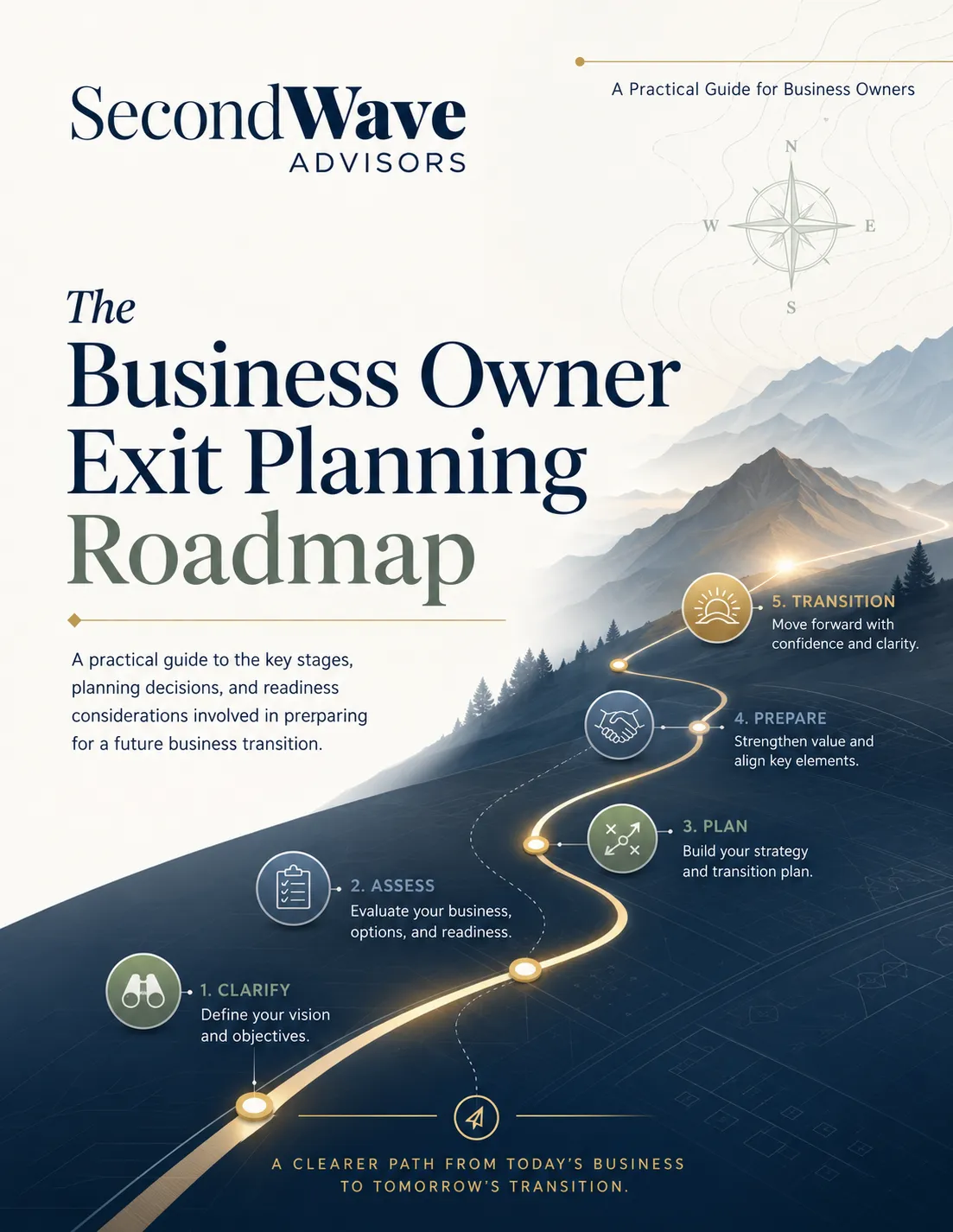
The Business Owner Exit Planning Roadmap
Understand the Key Stages of a Successful Business Transition
See how business, financial, personal, and transition planning decisions fit together so you can begin preparing before important decisions become urgent.
Exit Planning Can Be Difficult to Organize
Many Important Decisions Are Connected, but They Do Not All Happen at Once
A future transition may involve business readiness, financial information, personal priorities, family considerations, leadership continuity, transition options, professional advice, and implementation timing.

It Can Be Difficult to Know Where to Begin
Exit planning can involve business, financial, personal, family, tax, and transition considerations. The roadmap provides a clearer starting point.

Planning Efforts Can Become Disconnected
Business, financial, personal, family, legal, tax, valuation, and transaction considerations may develop separately without a shared roadmap.

Waiting Can Reduce Your Options
When planning begins after an unexpected event, unsolicited offer, family concern, or approaching deadline, there may be less time to evaluate alternatives.
A More Practical Way to See the Process
Use an Adaptable Roadmap Instead of Treating Exit Planning as One Decision
This roadmap organizes exit planning into five connected stages. Owners may move through the stages at different speeds,revisit earlier questions, and adjust the process as circumstances or professional guidance change.
No fixed exit date required
No assumption that every owner will sell
No single transition path treated as universally right
Useful whether planning is just beginning or already underway
Inside the Roadmap
Six Major Areas That Help Organize the Exit Planning Process
Use the roadmap to understand the major planning areas, identify questions that deserve attention, and see how different decisions may need to be coordinated over time.
Clarify Direction
Define business, financial, personal, family, timing, and future-involvement priorities.
Assess Readiness
Review business transferability, financial information, personal readiness, family considerations, leadership, and professional coordination.
Explore Transition Paths
Compare possibilities such as a third-party sale, family succession, management transfer, partner transfer, partial exit, re-capitalization, or continue downership.
Build and Prepare
Address owner dependence, leadership, systems, financial records, customer concentration, risk, documentation, and continuity.
Develop the Transition Plan
Coordinate timeline, responsibilities, valuation, legal and tax review, communication, contingencies, and the owner’s future role.
Coordinate People and Information
Consider the advisory team, due diligence information, risks, dependencies, and review dates that may support the process.
Why Begin Before a Transition Is Immediate
More Time Can Make It Easier to Sequence Decisions and Compare Options
Exit planning often involves dependencies. Earlier planning may provide more time to gather information, address readiness gaps, test assumptions, coordinate professionals, and adjust direction.
Benefit
Why It Matters
A Clearer Starting Point
The roadmap can help owners identify their current position and establish a manageable set of priorities.
Greater Flexibility to Compare Paths
Owners may have more time to evaluate alternatives rather than defaulting to the first available option.
Better Coordination Across Planning Areas
Business, financial, personal, family, leadership, legal, tax, valuation,and transaction questions can be considered within one process.
Get the Roadmap in Three Simple Steps
Step 1
Request the Roadmap
Complete the short form and request your complimentary copy.
Step 2
Review the Planning Areas
Use the roadmap to identify questions, priorities, and planning considerations that may deserve attention.
Step 3
Choose an Appropriate Next Step
Continue planning independently or discuss the areas you would like to explore further with the appropriate professionals.
Get the Free Roadmap
Start Organizing Your Exit Planning Process with Greater Clarity
Request Your Complimentary Roadmap
Complete the form and the download link for The Business Owner Exit Planning Roadmap will be sent to your email address.
What Happens After You Request the Roadmap
Step 1
Check Your Email
Your roadmap will be sent to the email address you provide.
Step 2
Review the Roadmap at Your Own Pace
Use the guide to consider which business, financial, personal, and transition planning areas deserve the most attention.
Step 3
Explore Your Readiness
If helpful, you may also choose to complete the Business Owner Exit Readiness Assessment for another perspective on areas of strength and potential gaps.
Step 4
Decide What to Address Next
Use what you learn to identify questions, priorities, or conversations that may deserve further attention.
Frequently Asked Questions About the Exit Planning Roadmap
Who is this roadmap for?
The Business Owner Exit Planning Roadmap is designed for owners who want a clearer way to understand the different decisions and planning areas that may be involved in a future business transition.
You do not need to have a buyer, successor, transaction, or exit date already identified to benefit from the roadmap.
Do I need to have selected an exit date or transition path?
No. The roadmap is intentionally designed to be useful before those decisions have been made.
It can help you begin organizing the business, financial, personal, family, and transition considerations that may influence which options ultimately make the most sense.
Does every business owner follow the same exit planning process?
No. Every owner's circumstances, business, family, financial needs, goals, and potential transition options are different.
The roadmap provides a flexible planning framework rather than prescribing one specific path or sequence for every owner.
Is the Exit Planning Roadmap free?
Yes. There is no cost to request the roadmap and no purchase is required.
Complete the short form and a copy of the Business Owner Exit Planning Roadmap will be sent to the email address you provide.
What happens after I request the roadmap?
After submitting the form, you will receive an email with access to the roadmap.
You may also receive occasional educational information related to business transition and owner readiness. You can unsubscribe from those communications at any time.
There is no obligation to schedule a meeting or engage an advisor after requesting the roadmap.
Does the roadmap provide legal, tax, financial, valuation, transaction, or other professional advice?
No. The Business Owner Exit Planning Roadmap is an educational resource intended to help business owners better understand and organize issues that may be relevant to a future transition.
It is not legal, tax, financial, investment, valuation, transaction, or other professional advice. Specific decisions should be considered with the appropriate qualified professionals.
See Your Exit Planning Process More Clearly
Request the roadmap to begin organizing the business, financial, personal, and transition considerations that may shape your future options.
This page and the Exit Readiness Discovery Call are provided for general educational and introductory discussion purposes only. The conversation is not a valuation, formal readiness assessment, due-diligence review, or substitute for individualized legal, tax, accounting, investment, financial, transaction, estate-planning, or other professional advice. No outcome is guaranteed.
Contact :
Andrew Williams | Second Wave Advisors 3091 Park West Ct. 888-993-9283 | [email protected] https://secondwaveadvisors.com/
© 2026 Second Wave Advisors. All rights reserved.